Most organizations don’t struggle because they lack policies. Most leaders don’t struggle because they lack information. They struggle because leaders interpret signals differently, delay critical decisions, escalate inconsistently, or act on assumptions rather than the facts.
The result?
Increased risk. Inconsistent management. Culture drift. Employee turnover. Organizational instability.
Policy alone cannot fix this. Training alone cannot fix this. What changes outcomes is judgment – the discipline to read situations clearly, decided consistently, and act before small signals become costly problems.
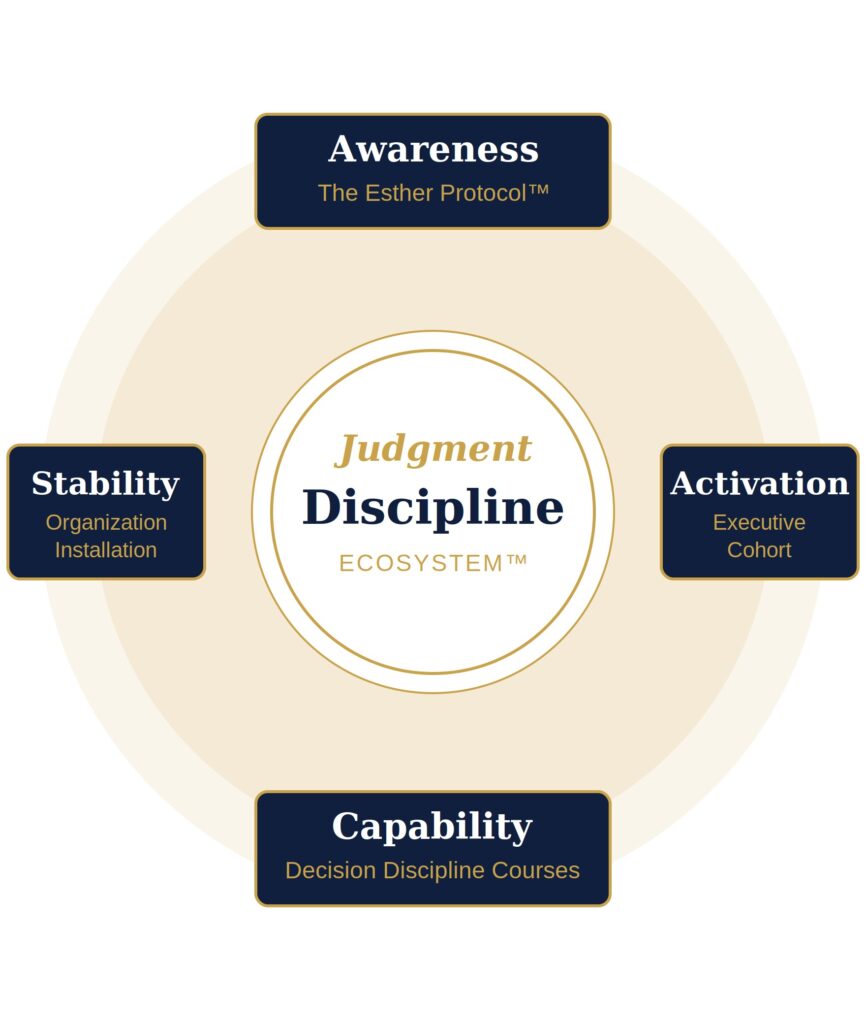
The Judgment Discipline Ecosystem™ helps individuals, leaders, and organizations strengthen decision-making, improve leadership capability, and create organizational stability through disciplined leadership practices.
Outcomes:
Every offering inside The Judgment Discipline Ecosystem™ is designed to solve the same problem: inconsistent decision-making. Whether you are navigating a career decision, leading a team, or strengthening organizational performance, the ecosystem provides practical tools and frameworks for improving judgment, reducing unnecessary risk, and increasing leadership capacity. The ecosystem consists of four interconnected parts: Awareness – Learn to anchor your identity. From there, learn to read the system around you and recognize the signals that precede every consequential decision. Activation – Evaluate options and commit to a strategic path forward. Capability – Develop the skills required to make effective decisions under pressure. Stability – Embed disciplined decision-making across teams and organizations through Organizational Installation. While each component serves a distint purpose, together hey support stronger decision making at the individual, leadership and organizational levels.
eBook: Navigate risk, power, and misalignment with greater clarity by anchoring your identity, reading the system, and strengthening judgment before making critical decisions.
Executive Cohort: Transform awareness into action by evaluating options, assessing risk, and committing to a strategic and tailored path forward.
Courses: Develop the judgment, discipline, and leadership skills required to make effective decisions under pressure.
Organizational 12-Month Program: Embed discipline decision-making across the employee life cycle to strengthen culture, reduce risk, and enhance the overall employee experience.
Crystal Wigfall, MBA, is a senior Human Resources executive and leadership consultant with over 19 years of progressive experience steering workforce strategy, employee relations, compliance, and organizational risk management across corporate, healthcare, nonprofit, and global consulting sectors. Her background also includes approximately five years managing inbound work-authorization processes for internationally recruited talent, including H-1B visa sponsorship and I-9/E-Verify compliance for foreign national employees relocating to the United States.
Having supported multi-state operations and executive leadership teams through complex workforce transformations, Crystal identified a critical systemic gap: while leaders often possess technical HR knowledge, they frequently lack a structured methodology for making high-stakes decisions under pressure. This insight led to her creation of the Judgment Labs™ and the Five C Framework™ (Clarity, Context, Consistency, Consequence, and Compassion) – a proprietary decision-making model engineered to mitigate organizational risk and stabilize operations.
As an educator and corporate facilitator, Crystal specializes in translating complex organizational challenges into high-impact, interactive learning experiences. Her instructional methodologies reject passive knowledge transfer, focusing instead on deep self-awareness, critical thinking, and collective group archetype debriefs to drive long-term behavioral change. Her flagship 6-hour live programs – spanning advanced workforce decision-making and international operational frameworks – explicitly embed ethical decision-making principles across the entire employee lifecycle.
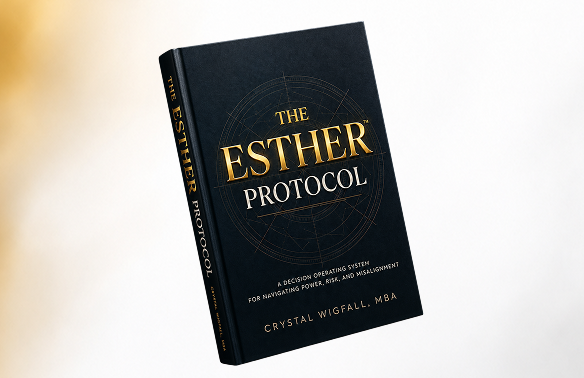
Crystal holds a Master of Business Administration and is the author of the forthcoming book, The Esther Protocol™: A Guide for Navigating Risk, Power, and Misalignment, equipping HR professionals and global business leaders with the practical tools required to navigate complex modern workplaces with accountability and strategic confidence.
A Guide for Navigating Power, Risk, and Misalignment.
Inside You’ll Discover:
Navigate risk, power, and misalignment with greater clarity by anchoring your identity, reading the system, and strengthening judgment before making critical decisions.
Most people are not struggling because they lack talent, intelligence, or capability. They are struggling because they are making decisions inside environments they do not fully understand.
When power, risk, and misalignment are present, it becomes easy to overperform, overexplain, seek approval, and carry responsibilities that were never yours to carry. Over time, people begin reacting to circumstances without understanding what is actually driving them.
Through Identity Anchoring™, Read the System™, and Judgment Discipline™, participants learn how to recognize patterns, separate signals from stories, and navigate complexity with greater clarity and confidence.
By the end of this stage, participants have a clearer understanding of themselves, their environment, and the decisions available to them. This clarity becomes the foundation for determining whether to stay, pivot, or exit – activating the next area of development in the ecosystem.
Transform awareness into action by evaluating your options, assessing risk, and committing to a strategic path forward with confidence, clarity, and discipline.
Understanding your situation is only the beginning. The next challenge is deciding what to do about it.
Many professionals recognize that something needs to change but remain stuck between competing priorities, uncertainty, fear, and responsibility. As a result, they delay decisions, remain in environments that no longer align, or make reactive choices without a clear strategy.
The Stay. Pivot. Exit.™ 6-Week Executive Cohort is designed to help participants evaluate their options, assess risk, and activate the decision that best aligns with their goals, values, and future direction. Through guided coaching, strategic planning, and peer learning, participants develop a personalized roadmap for moving forward.
By the end of this stage, participants have chosen a direction and developed a practical plan for executing it. This commitment becomes the foundation for building the capability required to sustain long-term success.
Develop the judgment, discipline, and leadership skills required to make effective decisions under pressure across complex workplace and organizational environments.
Knowledge alone does not improve outcomes. The ability to apply sound judgment does. The Judgment Discipline Ecosystem™ Decision Discipline Courses are designed to strengthen decision-making capability in increasingly complex workplace and organizational environments.
Rather than focusing solely on compliance, theory, or technical knowledge, the curriculum emphasizes application – participants learn how decisions influence employee experience, leadership effectiveness, organizational outcomes, and long-term stability.
Organizations operate within increasingly complex environments where leaders must regularly make decisions involving people, performance, risk, compliance, culture, and business objectives. While policies and procedures provide guidance, many workplace situations require leaders to exercise judgment when facts are incomplete, competing priorities exist, and outcomes may impact employees, teams, and the organization.
Decision Discipline Under Pressure™: A Judgment Framework for HR and Organizational Leaders is an interactive learning program designed to strengthen leadership judgment and improve decision-making consistency across the employee lifecycle. Through six scenario-based Judgment Labs™, participants examine realistic workplace situations spanning Attraction, Recruitment, Onboarding, Development, Retention, and Separation.
Using the Five C Framework™ — Clarity, Context, Consistency, Consequence, and Compassion — participants evaluate information, identify risks, assess potential outcomes, and develop a structured approach to decision-making. The focus is on how decisions are made, not simply what decisions are made.
Organizations operating across borders face a compounding layer of complexity that domestic workforce frameworks rarely address. Legal requirements differ by jurisdiction. Cultural norms influence how authority, accountability, and conflict are understood and navigated. What constitutes fair, consistent, and legally defensible judgment in one context may be inappropriate, ineffective, or non-compliant in another.
Decision Discipline Under Pressure™: Leading Across Countries, Cultures, and Regulatory Environments is an advanced interactive learning program that applies the Five C Framework™ to high-stakes, cross-border workforce decisions across the full employee lifecycle.
Through six scenario-based Judgment Labs™, participants examine realistic global workplace situations spanning Attraction, Recruitment, Onboarding, Development, Retention, and Separation, each layered with the cross-border complexity that makes these decisions genuinely difficult. Scenarios are designed to challenge assumptions, surface cultural blind spots, expose jurisdictional conflicts, and force participants to think beyond domestic defaults.
Using the Five C Framework™ — Clarity, Context, Consistency, Consequence, and Compassion — participants evaluate competing legal requirements, cross-cultural dynamics, organizational risk, and human impact before determining a course of action. The program does not offer easy answers; it develops the structured judgment required to navigate situations where the right decision is neither obvious nor universal.
This program is appropriate for HR professionals and organizational leaders who operate in global, multinational, or culturally diverse environments and need a repeatable, defensible process for making high-stakes workforce decisions across jurisdictions.
Artificial intelligence is reshaping how organizations attract, hire, onboard, develop, retain, and separate employees. Algorithmic tools now screen resumes, score performance, predict attrition, flag compliance risk, and recommend corrective action — often faster than any human reviewer could respond. The data appears objective. The process appears neutral. The output appears definitive.
It is not.
Every AI-assisted workforce decision still carries legal accountability, cultural consequence, and human impact. And in every case, a human leader remains responsible for the outcome — whether they exercised judgment or simply deferred to the recommendation.
Decision Discipline in the Age of AI™: Strengthening Human Judgment Framework in an Automated World is an advanced interactive learning program that examines what happens when artificial intelligence enters the employee lifecycle, and what human judgment must do in response.
Through six scenario-based Judgment Labs™, participants confront realistic situations across Attraction, Recruitment, Onboarding, Development, Retention, and Separation, each layered with AI-generated recommendations, algorithmic outputs, or automated processes that complicate the decision. Participants are not asked whether to use AI. They are asked what disciplined human judgment looks like when AI is already in the room.
Using the Five C Framework™ — Clarity, Context, Consistency, Consequence, and Compassion — participants evaluate AI-assisted information, identify what the algorithm cannot see, assess legal and ethical risk, and determine when to follow, override, supplement, or escalate an AI recommendation. The program is designed for the world HR professionals are already operating in, not the one they may have anticipated.
By the end of this stage, participants have developed the capability to apply disciplined judgment consistently across workforce, leadership, and organizational challenges. This capability becomes the foundation for creating greater organizational stability and long-term impact.
The Organizational Stability Installation™ helps executive teams create a shared operating system for workforce decision-making; building leadership alignment, clear ownership, stronger accountability, and organizational stability that lasts long after the engagement ends. This is not leadership training. It is the installation of decision discipline across your organization.
Every Executive Eventually Asks the Wrong Question:
“How do we improve culture?”
“How do we reduce turnover?”
“Why aren’t our managers consistent?”
“Why is HR overwhelmed?”
Those questions aren’t wrong.
They’re simply being asked too late.
By the time those questions appear on an executive dashboard, thousands of workforce decisions have already created the outcome.
Organizations rarely become unstable overnight. They become unstable one inconsistent decision at a time.
Why Your Organization Is Drifting
Most organizations already have policies. Procedures. Leadership training. HR professionals. Performance management systems.
Yet the same workforce problems continue to be repeated.
Why?
Because organizations rarely have a disciplined system for making workforce decisions.
Without a shared framework, every leader becomes their own policy.
One manager coaches. Another disciplines. One escalates immediately. Another waits six months. A policy applied differently. A difficult conversation avoided. An exception made just this once.
Individually, none of it seems significant.
Collectively, it redefines the organization.
That is Organizational Drift™ and most leaders don’t recognize it until the culture has already shifted.
The Five C Decision Framework™ changes that.
The Five C Framework™ is the decision methodology at the center of the Organizational Stability Installation™. It gives every leader in your organization a shared system for evaluating workforce decisions; regardless of pressure, personalities, politics, or changing business conditions.
Clarity: What facts do we actually know?
Context: What organizational, legal, and human factors matter?
Consistency: Would we make the same decision again under similar circumstances?
Consequence: What are the short- and long-term implications?
Compassion: How do we balance business outcomes with human impact?
When every leader evaluates decisions through the same five lenses, ownership becomes clear, inconsistency becomes visible, and the drift stops. The Organizational Stability Installation™ embeds the Five C Framework™ into the way your leadership team thinks, evaluates, and acts so consistent decisions stop being the exception and become the standard.
Most organizations think they have an accountability problem.
What they actually have is an ownership problem.
When ownership is unclear: HR carries responsibility without authority. Managers wait for permission. Executives assume someone else is handling it. Critical decisions stall. Risk compounds. Employees lose confidence.
Before improving judgment we establish ownership.
Because disciplined decisions cannot exist where decision ownership is ambiguous.
A full-day executive workshop introducing the Five C Decision Framework™ and establishing a shared decision language across the leadership team.
Leadership begins replacing reactive decision-making with a repeatable operating system.
Three executive deep dives using your organization’s real workforce decisions; not hypothetical case studies.
Hiring. Performance. Employee relations. Investigations. Accommodations. Restructuring. Succession. Organizational change.
Leaders strengthen judgment by solving the decisions they actually face; then carry that discipline forward through recurring Judgment Mic Drops delivered between sessions to sustain awareness and consistent application of the Five C Framework™ throughout the engagement.
Quarterly executive reviews identify recurring decision patterns, recalibrate leadership priorities, and measure organizational improvement.
Decision Discipline becomes how leadership operates; not something learned once and forgotten.
Across every leader. Across every employee. Across every stage of the employee lifecycle. Because the future doesn’t belong to organizations that know more. It belongs to organizations that decide better.